Ten thousand years ago, threats meant death. Snakes. Saber-toothed cats. Rival tribes. The rustle in the tall grass meant something wanted to eat you. Your body evolved a simple binary: fight or flee.
The machinery still works. But the predators have changed.
Now the threat is a silence after you speak in a meeting. A text message left on read. The flicker of disappointment in a partner's eyes. The possibility, however faint, that you are not enough.
And so we defend.
Some of us fight. We get loud. We over-explain. We poke holes in others before they can poke holes in us. Some of us flee. We withdraw. We go quiet. We decide, preemptively, that we are the problem, so we remove ourselves from the equation.
This is armor. Forged early. Worn daily. Invisible to the one wearing it.
And here is the thing about armor: it works. The steel that deflects the blade is real steel. The humor that deflects the compliment is real protection. The withdrawal that preempts rejection is a real wall against pain.
But protection has a shadow cost. The same wall that keeps the bad stuff out keeps the good stuff out, too.
The Animal
I am a flight guy.
I don't fight. I don't raise my voice. I don't throw punches, literal or metaphorical. When attacked, I retreat. I regroup. I let the scoreboard speak for itself.
This sounds noble when I write it. I take the high road. I don't engage in petty battles. Time vindicates the righteous.
But here's what it actually looks like:
When my team gets attacked in a meeting, my IQ drops. The words I need (the defense, the context, the counter-argument) vanish. They're not in my head. They're gone. I become an animal in flight, calculating escape routes while my team absorbs the blows.
Neuroscientists have a name for this. They call it an amygdala hijack.[1] The amygdala, an almond-shaped cluster of neurons that evolved to keep our ancestors alive, detects threat and triggers a response before the rational brain can intervene. Milliseconds. That's all it takes for ancient machinery to override modern judgment.
The problem is that my amygdala can't distinguish between a lion in the grass and a critical email from a stakeholder. Both register as danger. Both trigger the same cascade: cortisol, adrenaline, tunnel vision, the narrowing of thought to a single imperative. Escape.
I don't choose to go quiet. The choice is made for me by a brain that hasn't updated its threat assessment in ten thousand years.
The Collapse
At one point last year, I found myself in full retreat.
My team was under fire. We were delivering on our roadmap, but our stakeholders were on a different road altogether. We had picked the wrong problems to solve. They weren't unimportant. They weren't trivial. But in the feature factory mentality that dominates corporate life, the only problems worth solving are the ones someone else requested.
The stoplights on our scoreboards were a mixed bag of colors, painting a picture of a team that was busy but not aligned. Emails arrived with pointed questions. Meetings turned adversarial. And I did what I always do: I disengaged.
I retreated. I bided time for the team to clear the backlog, align on the right priorities, get back on the same road.
I told myself I was being strategic. Let the scoreboard speak. Time will vindicate us.
But there's a question that kept surfacing, one I first heard from Jerry Colonna, the executive coach who asks CEOs the questions they've been avoiding their whole lives:
"How have you been complicit in creating the conditions you say you don't want?"[2]
I wanted trust. I wanted recognition. I wanted to feel like my contribution mattered. And my response to not getting those things was to withdraw further, to make myself less available, less vulnerable, less present.
The scoreboard can't hold you. The scoreboard doesn't see you. The scoreboard never says, I understand what that cost you.
The Workshop
In December, I walked into the three-day Interpersonal Leadership Circle, led by Green Tara Leadership. The program was inspired by Stanford's famous "Touchy Feely" course[3], a crucible of interpersonal dynamics where participants give and receive feedback in real time through a unique methodology known as "T-Group". Designed and led by Tara Hill, a half-Vietnamese Stanford GSB alumnae, the program blends mindfulness, emotional coaching, and interpersonal feedback.
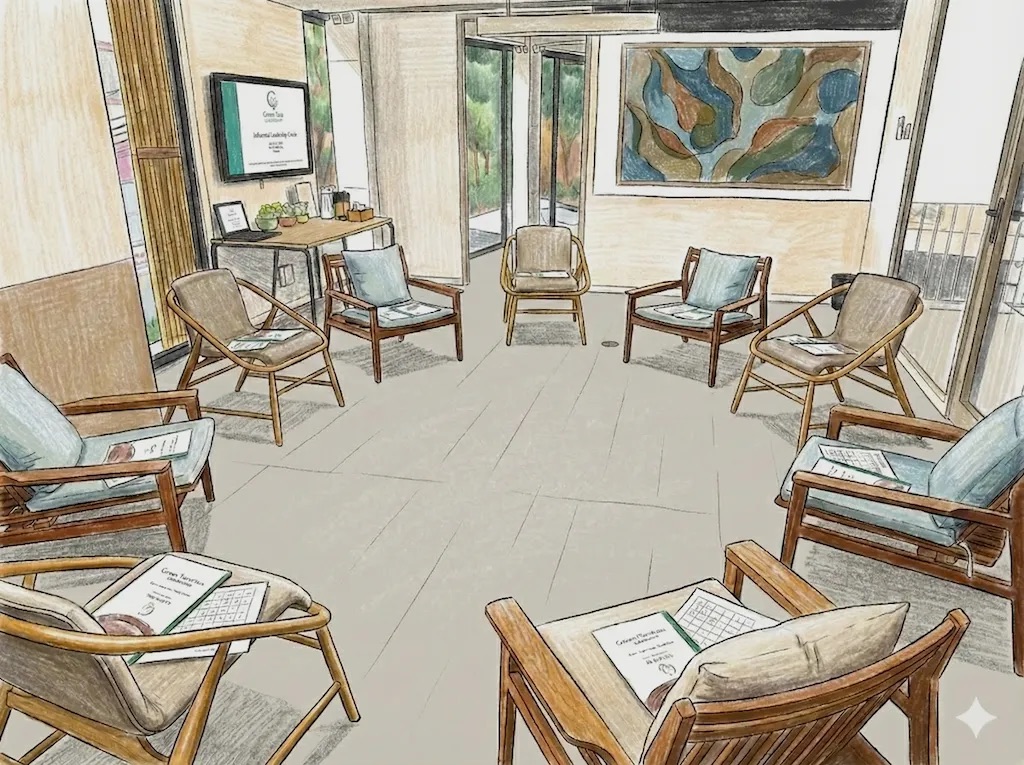
The workshop teaches a concept called "Your Side of the Net."[4]
Imagine a tennis court. On your side is everything you know for a fact: your feelings, your actions, the data. On the other side is everything you can only guess: the other person's motives, their intentions, their character.
When we feel unsafe, we cross the net. We don't say, "I feel dismissed." We say, "You are arrogant." We stop talking about our experience and start prosecuting their character.
I thought I was good at this. I'm a rational guy. I stick to facts.
When I shared my Day One reaction with the group, something shifted.
People felt judged. The judgment wasn't in what I said, but in what I implied: that their struggles were somehow less legitimate than my "professional" concerns, that emotional work was beneath the real work I came to do.
I had crossed the net. Without meaning to, I had landed on their side of the court, implying something about their motivations, their priorities, their seriousness. My analytical distance read as superiority. My armor was visible to everyone but me.
And then the feedback came.
Over the course of Day Two, participants named what they experienced when I spoke. The ways I deflected. The jokes that landed like walls. The moments I stepped over someone's vulnerability to make a point.
I was defensive. I over-explained. I tried to convey what was actually going on for me: the loneliness, the hunger for recognition, the sense that while I was locked in this workshop processing emotions, my team back at the office was hitting one of our biggest annual goals. There would be no pat on the back because I wasn't there to receive it.
But the more I explained, the further away I got. The less they heard.
It's hard to describe what happens when you finally see a pattern you've been living inside your whole life. It's like watching security footage of yourself. You see a gesture you've made a thousand times, a deflection, a joke at exactly the wrong moment, but this time you see it from the outside. You see how it lands. You see what it costs.
I saw it. Clearly. For the first time.
I had spent years using humor to deflect the very thing I was starving for. Every joke that brushed off a compliment, every quip that dissolved a tender moment. They weren't protecting me. They were isolating me. Someone would reach toward me, and I would make them the punchline. I would take their bid and bat it away, and then I would wonder why I felt so unseen.
The room was quiet. My face got hot. I could hear my heart pounding. And my eyes filled with water.
No one rushed to fill the silence or rescue me from the discomfort. I just sat there, processing. In silence.
After what felt like an eternity, the facilitator asked what I was feeling.
I looked for the sense of shame. I searched for that urge to run. I scanned for the usual misery. But only one word came out.
Joy.
It didn't make sense. I was crying in a room full of strangers. I had just been dismantled. But the feeling wasn't pain. It was the sheer, impossible relief of putting the heavy thing down. I had dropped the shield, and nobody had stabbed me.
The Paradox of Joy
This is the part that doesn't make sense until you understand what Brené Brown discovered in twelve years of studying vulnerability.
Joy, she found, is the most vulnerable emotion we experience.[5] More than fear. More than shame. Joy.
She calls it "foreboding joy": the way we instinctively brace against happiness, waiting for the other shoe to drop. We're afraid the feeling won't last. We're afraid something will take it away. So we dress rehearse tragedy. We imagine the worst so we won't be blindsided by it. We beat vulnerability to the punch.
I am not a happy-go-lucky guy. My humor is sarcastic. I am a natural cynic. I am not plagued by self-doubt, but I carry doubt in others. I question motives. I hold back. I wait to see if people will prove themselves before I invest.
If you're reading this and thinking it sounds soft, I get it. I thought the same thing walking into that workshop.
Tara, the Circle's facilitator and coach, says, "I've learned to expect armor and high defense walls from leaders on Day 1. Part of the transformation process is helping leaders to understand just how much that armor is costing them, personally and professionally."
This echoes what I've learned first-hand: the armor doesn't make you stronger. It makes you slower, lonelier, and easier to blindside.
Beneath the cynicism, my true self believes in the future. Believes in possibility. Believes that things can be better than they are. The cynicism isn't who I am. It's armor. It's the part of me that learned it was safer to expect disappointment than to be surprised by it.
When Circle members offered me acknowledgement, something in me recognized it as real. And that recognition terrified me. Because if I let it in, if I softened into the joy of being seen, I would be exposed. It could be taken away. So I made a joke. I kept myself safe.
And in doing so, I pushed away the very thing I was starving for.
The tears in that room weren't grief. They were release. For the first time in longer than I could remember, I let myself feel joy without bracing against it. I let it in. I let it be real. And the vulnerability of that, the sheer exposure of sitting in a room full of people while tears ran down my face, was the most alive I had felt in years.
The Exposure
After the workshop, the walls were gone. They hadn't been repaired. They'd been demolished. The window wasn't cracked; it was shattered. And the air was rushing in.
I went for a run and cried at kilometer ten. No reason. Just release.
I went to a friend's daughter's dance recital and bawled mid-performance.
I watched Home Alone and cried when Kevin's mom finally walks through the door on Christmas morning.
I held a year-end sharing session with my team. We went around the table, reflecting on the year: the struggles, the wins, the growth. As I acknowledged each person, what they'd contributed, who they'd become, a single tear ran down my face. I didn't wipe it away.
I had my own performance review with my boss. I stayed in that raw, open space. At one point, he asked if we should hug. We didn't. But the fact that he asked meant something. He was there. He saw me.
It felt ridiculous. But it also felt alive.
This is what it feels like when the armor comes off. Lighter. Easier. Terrifying.
Brown writes that you cannot selectively numb emotion.[6] You can't say, here's the bad stuff (the fear, the shame, the grief) and I don't want to feel these, and expect to keep the good stuff. The same armor that blocks pain blocks joy. I had spent years protecting myself from disappointment, and in doing so, I had also protected myself from the very connection I craved.
The Walk
A few days later, I did something I'd been avoiding for months.
I went to my main stakeholder, the one whose criticisms had sent me into retreat, and said: We have to talk about trust.
It started awkwardly. I stumbled over the words. But once I stayed on my side of the net, we found space to have an open conversation.
I didn't tell him what his problem was. I didn't attribute motives to his behavior. I didn't say "You don't trust me" or "You're being unfair." Those statements, however true they might have felt, would have landed on his side of the court. They would have triggered defensiveness. We would have spent the conversation debating whether my assessment of him was accurate instead of talking about what was actually broken between us.
Instead, I spoke from my experience.
"When trust breaks down between us," I said, "I feel demotivated. And I stop fighting for the results we both want."
Marshall Rosenberg, the psychologist who developed Nonviolent Communication, built his entire framework on a simple insight: behind every judgment is an unmet need.[7] When we learn to identify and express our needs directly, rather than encoding them in criticism or withdrawal, connection becomes possible.
Expressing my emotions gave him space to speak directly too. He shared what was actually going on for him: the concerns he hadn't voiced, the criticism he'd been holding. For the first time in months, we weren't performing. We were just two people speaking out loud what had been left unsaid.
There's an old saying: "if you name it, you can tame it." The things that fester in silence lose their power when spoken aloud. Our relationship didn't transform overnight. But something shifted. The air cleared. We could finally see each other.
The conversation took twenty minutes. The retreat had lasted three months. That's the cost of disconnection. Not the arguments you lose. The time you waste hiding from them.
Vulnerability isn't inefficient. Avoidance is.
References
- Daniel Goleman, Emotional Intelligence: Why It Can Matter More Than IQ (New York: Bantam Books, 1995). Goleman coined the term “amygdala hijack” to describe the phenomenon where emotional responses bypass rational thought. ↩
- Jerry Colonna, Reboot: Leadership and the Art of Growing Up (New York: Harper Business, 2019). This question has become a cornerstone of Colonna’s executive coaching practice. ↩
- Interpersonal Dynamics (OB 374), commonly known as “Touchy Feely,” has been the most popular elective at Stanford Graduate School of Business for over fifty years. More than 90% of MBA students take the course. ↩
- The “Net Model” of feedback is taught in Stanford GSB’s Interpersonal Dynamics course and is detailed in David Bradford and Carole Robin, Connect: Building Exceptional Relationships with Family, Friends, and Colleagues (New York: Currency, 2021). ↩
- Brené Brown, Daring Greatly: How the Courage to Be Vulnerable Transforms the Way We Live, Love, Parent, and Lead (New York: Gotham Books, 2012). ↩
- Brown, Daring Greatly. The full quote: “We cannot selectively numb emotions. When we numb the painful emotions, we also numb the positive emotions.” ↩
- Marshall B. Rosenberg, Nonviolent Communication: A Language of Life, 3rd ed. (Encinitas, CA: PuddleDancer Press, 2015). ↩