There is a course at Stanford Graduate School of Business that students regularly describe as the most transformative experience of their MBA. It is not a finance class. It is not a strategy seminar. It is a course called Interpersonal Dynamics — and at its center is something called the T-Group.
If you have never heard of a T-Group, you are not alone. It is not widely marketed. It does not have a flashy framework or a bestselling book behind it. And yet, for more than six decades, it has quietly been one of the most powerful tools for developing leaders who can truly connect with the people around them.
Below is an overview of the T-group methodology and why we believe this methodology matters more now than ever.
A Brief History of T-Group Methodology
The T-Group — short for "training group" — was originally developed in the late 1940s at the National Training Laboratories (NTL) in Bethel, Maine.1 Social psychologist Kurt Lewin and his colleagues discovered something remarkable: when people gathered in small groups and paid close attention to their real-time interactions, something shifted. People started to see themselves more clearly. They began to understand how they affected others — and how others affected them.
Stanford Graduate School of Business adopted and refined this methodology into what became the Interpersonal Dynamics course, affectionately known by students as "Touchy Feely." Over the decades, it evolved into one of the most sought-after courses at Stanford, with a long waitlist every year. Faculty like David Bradford and Carole Robin built the course into a rigorous, deeply researched approach to developing interpersonal effectiveness.2
What is interesting is that this is not therapy, and it is not team-building in the way most people think of it. It is something altogether different.
So What Actually Happens in the Room?
Imagine sitting in a circle with eight to twelve people you do not know. There is a facilitator present, but there is no agenda, no lecturing, no predetermined topic. The only instruction is this: pay attention to what is happening in this group, right now, between us — and talk about it honestly.
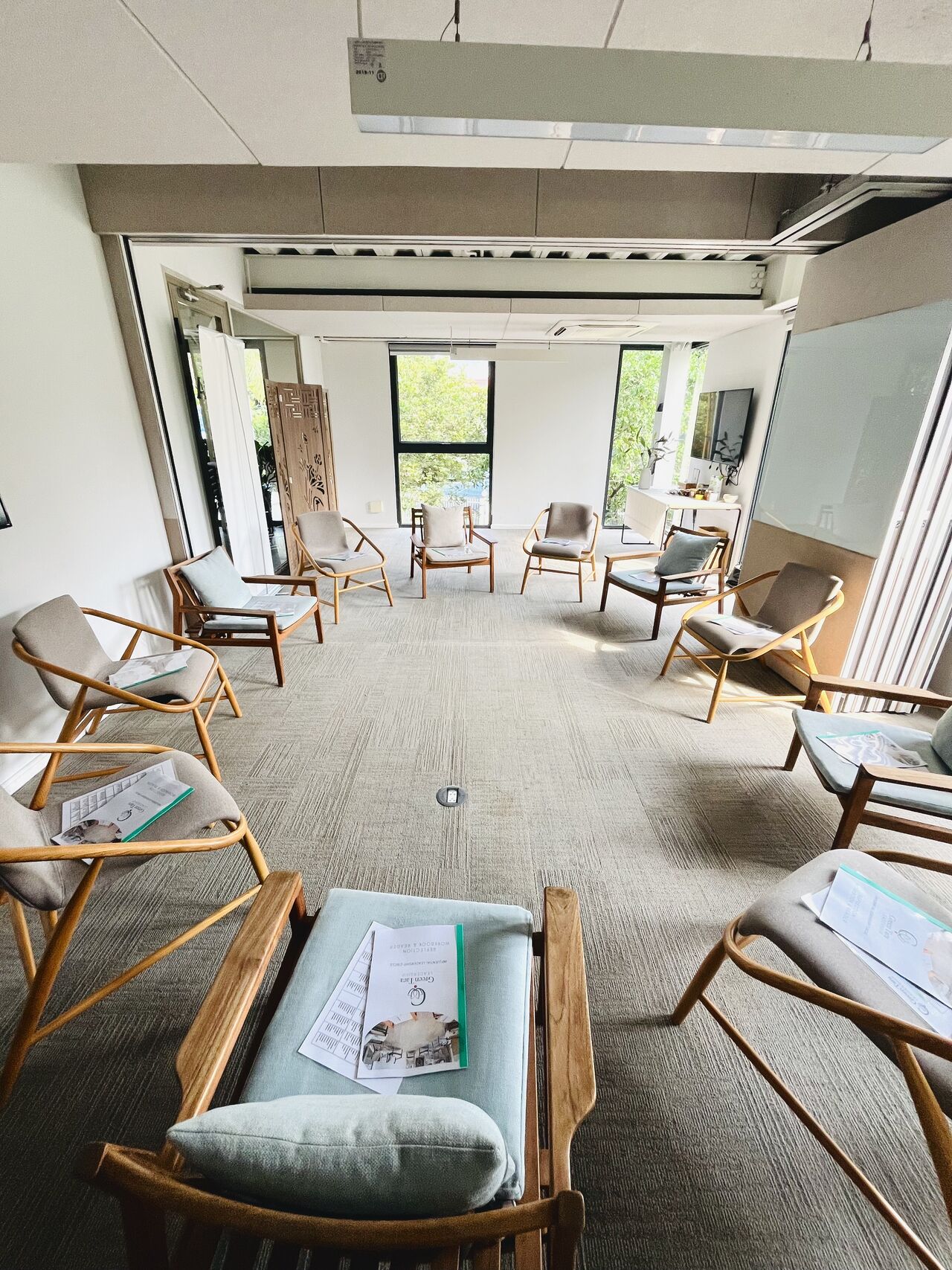
That is it. And that simplicity is precisely what makes it so powerful.
Without an agenda to hide behind, people start showing up as they actually are. The person who always takes charge begins to notice they do it here too — and starts to wonder why. The person who stays quiet realizes that their silence is not neutral; it has an effect on the room. The person who makes everything into a joke begins to see what they might be avoiding.
Similarly, without a designated leader in charge, a vacuum opens up in which participants are able to experiment with how to actually influence without authority. To understand the types of behaviors that increase interpersonal connection and influence, and the types of behaviors that decrease it. To gain answers to the following question: “If I remove my title, my role, my status – and all I have left is myself and the way I show up – why would others choose to follow me?”
The facilitator's role is not to lecture or direct. It is to create conditions of safety and to gently invite the group to notice patterns as they emerge. When someone says something that lands differently than they intended, that becomes a moment of learning. When the group avoids a difficult topic, the facilitator might name that avoidance — and invite curiosity about it.
"The Leadership Circle creates a laboratory for human interaction. Dynamics that play out in your career surface in the room. But unlike real life, you get real-time feedback."
Hawkins Pham, former Green Tara Leadership Circle Participant
What Participants Experience
For many of the leaders we work with, the first hours of a T-Group feel unfamiliar.
- Some feel impatient — where is the content?
- Some feel anxious — what am I supposed to do, where are the instructions?
- Some try to take over.
- Some withdraw.
All of these responses are useful information.
What tends to happen, gradually and then suddenly, is that people begin to take real interpersonal risks. Someone shares that they felt dismissed by a comment made an hour ago. Someone else admits they have been holding back because they are afraid of being judged. A third person says, honestly, that they noticed they were trying to impress the group rather than be genuine.
These moments are where the learning lives. Not in the abstract, not in a case study about someone else's company, but right here, between real people, in real time. When a leader hears from three different people that they come across as warm but distant — that they share ideas but rarely share themselves — it lands differently than any 360 review ever could.
We have seen leaders come into the Circle certain they were great listeners, only to discover that what they thought was listening was actually waiting to speak. We have seen leaders who believed they were approachable learn that their intensity kept people at a careful distance. These are not failures. They are blind spots that become visible in the T-Group — and once you can see them, you can choose what to do about them.
Why This Methodology is Powerful for Leaders
Most leadership development focuses on what to do. Read this framework. Follow this process. Implement this system. In other words, tactics and actionables. Yet so often, leaders return to work on Monday and forget what they have learned, or fail to implement it because their underlying belief system has remained unchanged.
The T-Group works differently. It focuses on who you are when you are in relationship with others — and that is where leadership actually lives. By experiencing and witnessing your own patterns and relational dynamics in real-time, decades-old beliefs can be overturned in just 3 days.
The leaders who have the deepest impact are not the ones with the best strategy decks. They are the ones who can sit with discomfort, who can hear hard truths without becoming defensive, who can be honest without being harsh, who can be vulnerable without losing their authority. These are not skills you can learn from a textbook. They are capacities that develop through practice, in relationship, with other people. And doing so often requires re-wiring existing self-limiting beliefs about ourselves or about our interpersonal dynamics that can only be overturned when you feel something radically different in your body, in relationships with others, in real-time.
What is interesting is that the effects tend to show up quickly in real life. Leaders return to their teams and notice things they did not notice before. They hear the unspoken tensions in a meeting. They catch themselves falling into old patterns — and they pause, and they choose differently. Gradually, their behaviors and energies shift too. They become more emotionally attuned to their teams, more open to bids for connection from others. They embrace feedback whole-heartedly – both giving and receiving it. They show up lighter – with more presence and more authenticity. Their teams notice the shift, even if they cannot name it.
How We Bring T-Group Methodology Further
The T-Group is powerful on its own. But we have found that leaders go deeper, and more safely, when the room is held by someone attuned to the body and the heart, not just the group dynamic.
That is why our Founder and Lead Coach, Tara Hill, takes the foundational T-group methodology further. Alongside the classic T-Group process, she draws on years of heart-centered facilitation and body-based coaching to help each person arrive not just mentally ready, but grounded — in their body, in their emotions, before the harder conversations begin.
In practice, Green Tara Leadership Circles incorporate our own signature approach and blend the following dimensions with the Stanford-inspired Interpersonal Dynamics method:
- Body-Awareness and Mindfulness: Close attention is paid to bringing leaders into their bodies, supporting them to become more mindful of their physical and emotional sensations in the present moment.
- Guided Emotional Processing: Expert facilitators guide individuals with deep safety and care to become more aware of their emotions, to process and release them, and to express them to others in a constructive way.
- Head-Heart-Gut Alignment: Participants are guided away from their often over-dominant head-brains to awaken the often-overlooked heart and gut brains. They learn to feel what it’s like to lead and show up from an integration of all three.
- A Container for Deep, Human Connection: The entire program is designed and facilitated with safety at the core, and with the intention to create a lived experience of deep, human connection.
This matters because interpersonal risk-taking only works in a room where people feel safe enough to take it. So before we ask leaders to be vulnerable with each other, we make sure they are first grounded in themselves — settled enough in their own body and emotions to show up honestly, and steady enough to hear what comes back.
We also believe these heart- and body-focused approaches are critical to deep transformation work, because while a leader can understand a piece of feedback intellectually, it does not mean they actually feel it, or trust it enough to act on it. Our facilitation is designed to close that gap — to help people move from knowing something to feeling it, and from feeling it to embodying it. Behavior change only becomes sustainable once you’ve felt and embodied a transformative impact from it, not because you’ve rationalized your way into it.
How to Prepare
Rest and be present
The Circle asks a lot of you, emotionally and energetically, over three days. Come in as rested as you can, and try to protect that rest through the program itself. It can help to let your family or the people close to you know you will be going through something intensive — that you may be harder to reach, and less present than usual, while you are in it. Clearing space beforehand is part of the preparation.
Be open, and be willing to try
You do not need to have this figured out before you arrive. Some of the most meaningful moments in Circle come from people who were willing to say the scary thing, ask the risky question, or sit in a silence they would normally rush to fill. Learning in a T-Group setting comes from being vulnerable, and from being willing to step outside of your comfort zone.
Prepare your learning goals
Before you arrive, get honest with yourself about what you actually want from this experience — not the polished or rehearsed version that sounds good, but the real interpersonal learning goals you are hoping to achieve. Remember that this experience provides a unique opportunity to help you build more meaningful relationships in all spheres of life, and to become more in touch with your authentic self. You will be asked to share this with the group on Day 1, so it helps to walk in with at least a rough sense of your goals.